Asana acquires StackAI — now every human-agent workflow runs in one place.Learn more
What is a Scrum Master? Role, skills & salary guide


Summary
Scrum masters lead teams that use the Scrum methodology, an Agile framework that helps teams build and iterate quickly. The main pillars of Scrum are transparency, inspection, and adaptation, and the Scrum master uses them to guide the team's work. Since Scrum leads to faster outputs, Scrum masters need to be organized and engaged in the workflow to ensure nothing is overlooked.
In this guide, we'll discuss what a Scrum master is and their responsibilities. If you're a Scrum master, are looking to bring one on, or are interested in becoming one, you can use this guide as a resource to better understand how a professional Scrum master works.
Master AI-Powered Workflow Optimization
Ready to revolutionize your team's productivity with AI you can trust? Join industry leaders from Asana and Anthropic to learn proven strategies for implementing AI across your workflow stages and unlock the full potential of Asana's AI Studio.
What is a Scrum master?
A Scrum master is a servant leader who guides a Scrum team through the Scrum methodology, ensuring team members stay focused on Scrum principles and practices. Rather than directing the team, they coach members to become self-reliant through self-organization and conflict resolution.
Key characteristics of a Scrum master include:
Facilitation focus: They run Scrum ceremonies like daily stand-ups, sprint planning, and retrospectives.
Servant leadership: They remove obstacles so the team can do their best work.
Coaching mindset: They help team members grow and improve continuously.
What does a Scrum master do?
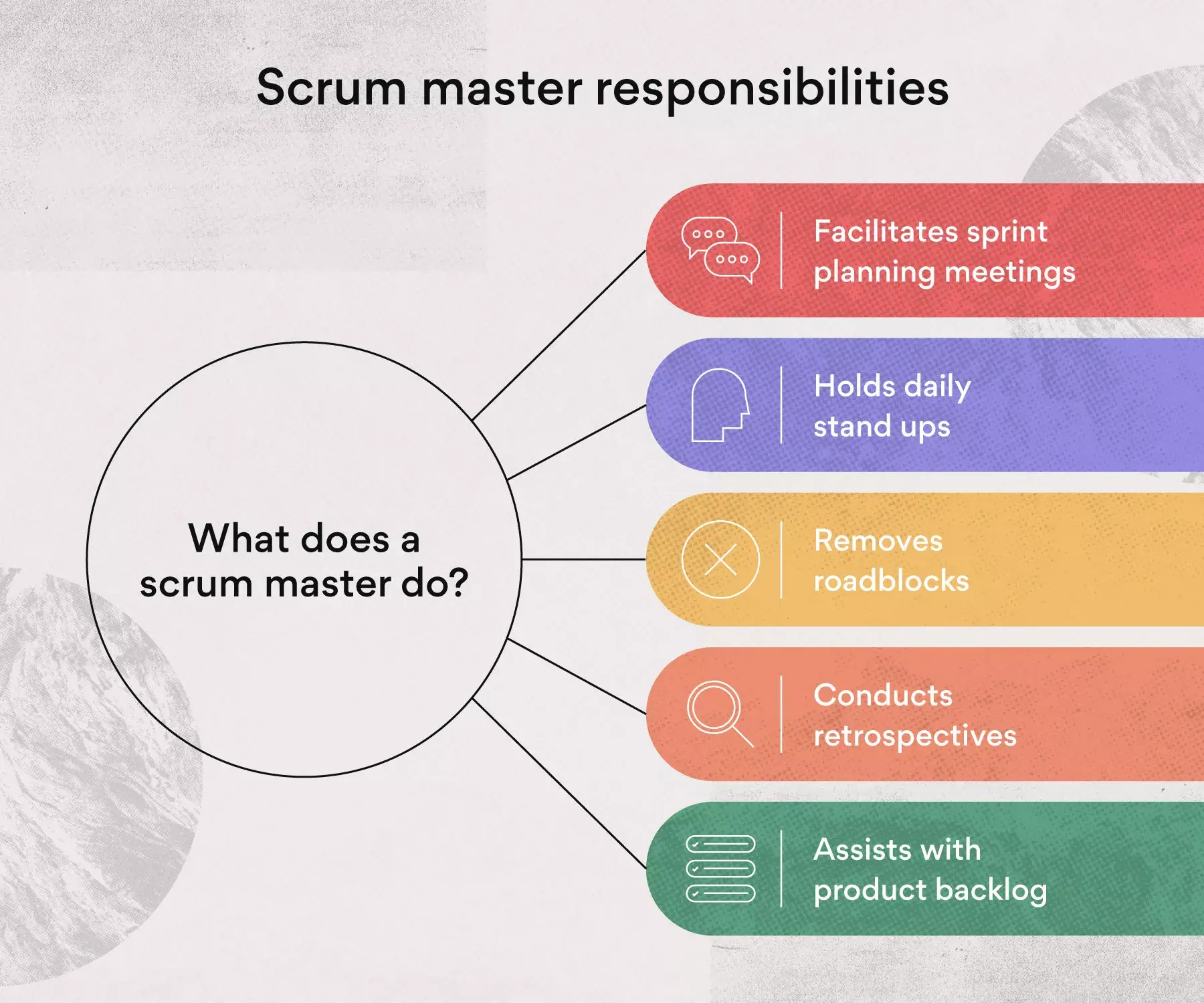
Scrum masters help keep projects organized and on track through a series of processes and steps. Here are the five Scrum master responsibilities that help the team.
1. Facilitates sprint planning meetings
Sprint planning meetings help your Scrum team decide which items from the product backlog to prioritize for the next sprint. These meetings are collaborative, typically involving the Scrum master, product manager, and the team of developers, all of whom are encouraged to speak up.
During a typical sprint planning meeting, the Scrum team:
Comes prepared with data and estimates to support your next sprint project.
Confirms estimates for items on the sprint product backlog.
Agrees on the product backlog items for the next sprint.
Assesses the team's capacity for the next sprint.
Ends the meeting with a Q&A session.
These meetings emphasize collaboration, giving developers a chance to address what tasks they think deserve the most attention.
2. Holds daily stand-up meetings
Daily Scrum stand-up meetings are an essential part of the Scrum framework and will be your responsibility as Scrum master. As the Scrum master, you'll facilitate these meetings and use them to assess progress toward the sprint goal.
The main questions asked in daily stand-ups include:
What did you do yesterday?
What will you do today?
Is anything blocking your progress?
3. Removes roadblocks
Problem-solving is a key quality of any good Scrum master. As the leader of your Agile team, you'll want to move the project along as quickly as possible and make it easier for your team members to get their work done. If you notice impediments blocking the work, your job is to resolve the issue or find someone who can.
A potential roadblock, for example, may include a lack of understanding between Agile teams and stakeholders. The Scrum master can address this issue by inviting stakeholders to a few planning sessions to help them better understand how to be Agile.
Read: Turn your team into skilled problem solvers with these problem-solving strategies4. Assists with product backlog
Scrum masters are leaders and team members. When there's time to spare, you can roll up your sleeves and help your developer team with backlog refinement and work through the product backlog.
The product backlog may involve features, tasks, bug fixes, technical debt, or knowledge acquisition. Because you have ample knowledge of Scrum and product development, you can jump in to help your fellow team members.
5. Conducts retrospectives
Sprint retrospectives are review meetings held after each sprint to evaluate what went well and what didn't. These meetings give Scrum team members a chance to identify areas for improvement during future sprints.
Some questions to ask during the retrospective include:
How did you do this sprint?
Where and when did it go wrong in this sprint?
Which tools or techniques proved to be useful? If you could change one thing, what would it be?
Scrum master vs. project manager
The project manager is the non-technical counterpart to the Scrum master. While both roles solve problems, the project manager focuses on the project itself, while the Scrum master focuses on the team and their success.
Aspect | Project Manager | Scrum Master |
Primary focus | Project success and deliverables | Team success and Agile practices |
Leadership style | Directive management | Servant leadership and coaching |
Team involvement | Oversees from a distance | Actively participates in Scrum events |
Key responsibilities | Timeline, scope, task assignment | Facilitation, impediment removal, coaching |
Scrum master roles
As a Scrum master, you may have many roles. You'll relay information from upper management, meet the needs of external stakeholders, and monitor your Scrum team's progress.
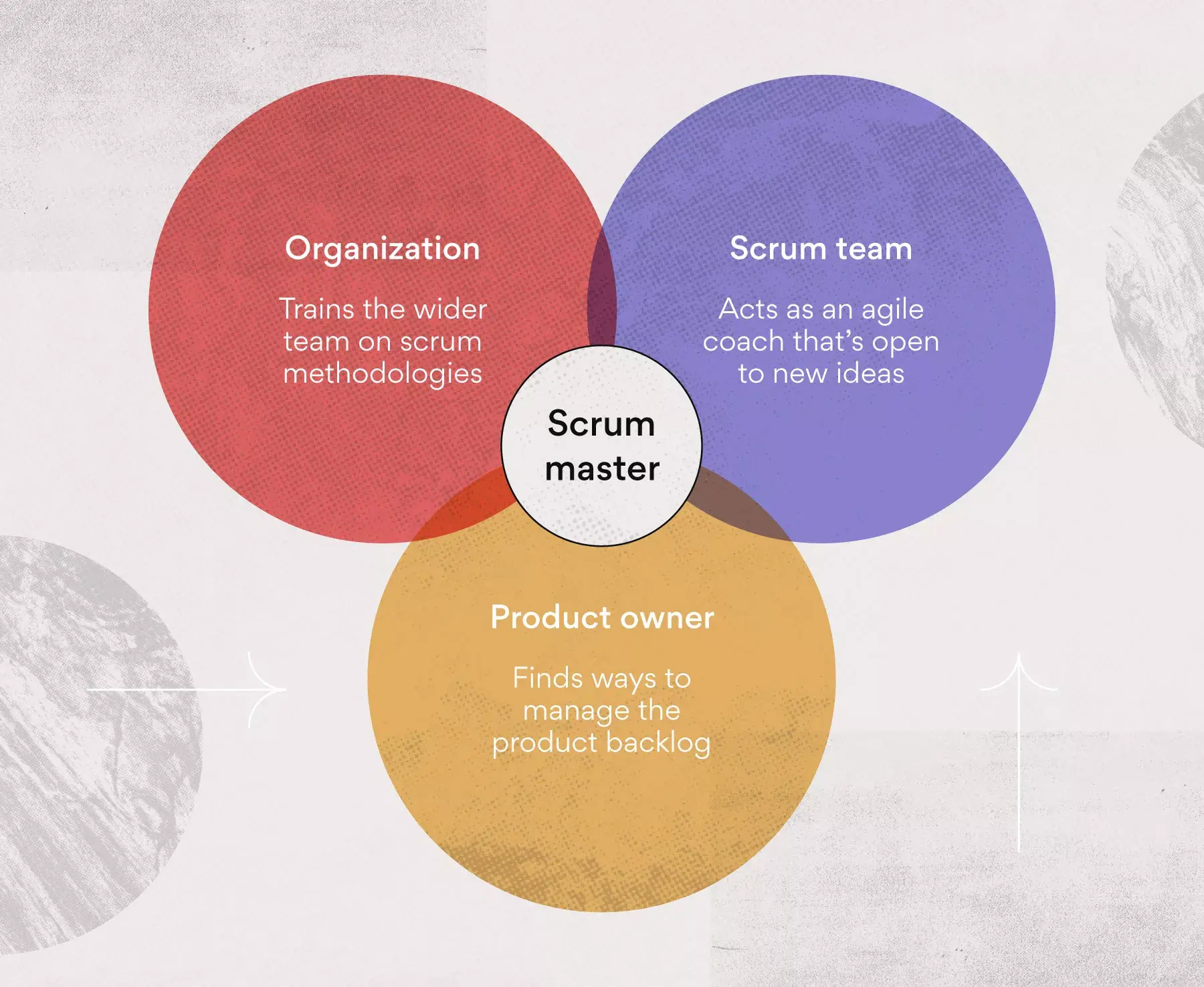
Below are just a few of the many hats Scrum masters wear:
Act as an Agile coach: As a Scrum master, your primary job is to serve your team by coaching them in Agile practices. In Agile, team members work in focused blocks of time to complete tasks. As the Scrum master, you must remain flexible and open to ideas when coaching your team through this iterative process.
Collaborate with the product owner: Scrum masters support the product owner, who is mainly responsible for managing the product backlog. The product backlog is often composed of user stories, which can be complex and ever-changing. As the Scrum master, you should help the team understand how to read user stories so they can effectively sift through the product backlog during sprint planning.
Share knowledge with the organization. You'll serve as the Scrum master, leading and training others in the Scrum methodology. When you help both internal team members and external stakeholders understand the Scrum guide, you can remove barriers between already established Scrum teams and other employees.
Scrum master skills
As a key figure in Agile software development; the Scrum master is responsible for guiding and optimizing team performance. Common Scrum master skills include facilitating daily stand-up meetings and promoting self-management to elevate the team's success.
Effective communication
Effective communication is a key skill for Scrum masters. You need to clearly share goals and tasks during daily meetings to help the team understand and work together. Good communication keeps everyone aligned, reduces confusion, and makes the team more productive.
Team management
A Scrum master also needs to be a capable team leader. They might lead a cross-functional team through a complex project and encourage self-management and accountability. Effective team management involves building a strong, self-sufficient unit that can overcome obstacles efficiently.
Implement Agile methodologies
A Scrum master must have a strong understanding of Agile methods, such as Scrum and Kanban. These Agile skills help teams use adaptable, iterative methods that evolve based on project needs, leading to higher output and quality.
If you're wondering whether adopting Scrum is right for your team, begin with a Scrum template to simplify sprint planning and coordinate your team members.
Championing change and innovation
Facilitating change and innovation is an essential Scrum Master skill. They might introduce new tools or processes, like a turndown or burn-down chart, to improve project tracking. This skill keeps teams at the forefront of industry advancements and safeguards continuous improvement and a competitive edge.
How to become a Scrum master
Becoming a Scrum master usually involves learning, building skills, and often getting certified. Everyone's path is different, but here are the main steps to get started.
Education requirements
Scrum masters often have a background in business or technology, but you don't always need a formal degree. Many companies value hands-on experience and special Scrum training just as much.
Common educational backgrounds include:
Bachelor's degree: Computer science, information technology, or business management
Project management knowledge: Familiarity with PM principles and software development processes
Advanced education (optional): Master's degree in project management or IT for leadership roles
Scrum master career path
The path to becoming a Scrum master often starts in project management or software development roles. Over time, you gain experience with Agile methods and move into the Scrum master position.
A typical career progression looks like:
Entry-level roles: Junior project manager, software developer, or business analyst
Skill development: Taking on project coordination and Agile responsibilities
Transition: Leading Scrum meetings and facilitating team collaboration
Growth: Mentoring others in Scrum practices and expanding organizational influence
Scrum master certification
Getting certified can help your job search and show your Scrum skills. There are different certifications for various experience levels and Agile approaches.
Certification | Best for | Focus |
Certified ScrumMaster (CSM) | Beginners | Foundational Scrum knowledge and team collaboration |
Professional Scrum Master (PSM) | Intermediate practitioners | Deep understanding of Scrum principles and process theory |
Disciplined Agile Scrum Master | Enterprise environments | Comprehensive Agile application in complex settings |
SAFe Scrum Master (SSM) | Scaled Agile organizations | Scrum master role within the Scaled Agile Framework |
How much does a Scrum master make?
A Scrum master's salary can vary a lot based on where you work, your experience, and your industry. In general, Scrum masters are well paid because there is a high demand for their skills in Agile software development.
According to Glassdoor, the average salary for a Scrum master in the United States is $126,109 per year, with a typical pay range of $99,207 (25th percentile) to $161,793 (75th percentile). PayScale reports the average salary for a Scrum master is $106,034 in 2026.
Factors that can influence salary include:
Geographic location: Salaries tend to be higher in major tech hubs and metropolitan areas.
Industry: Finance, healthcare, and technology sectors often offer higher compensation.
Certifications: Holding certifications like CSM, PSM, or SAFe can increase earning potential.
Experience level: Senior Scrum masters with 5+ years of experience command higher salaries.
Do you need a Scrum master?
Your team can decide if you need a Scrum master by looking at the challenges you face.
Does your development team have trouble prioritizing items in the product backlog? Teams that struggle with this can benefit from a Scrum master who understands Scrum principles well.
Does your team work better with a coach than with strict leadership? Some people don't do well with very rigid leaders. A Scrum master leads more like a coach and less like a micromanager.
Does your team need someone to run check-in meetings? If you need a person to guide the Scrum team, spot problems, and lead regular meetings, a Scrum master could help.
A Scrum master can improve your team's workflow and involvement while making sure Scrum values stay important.
Read: Understanding the iterative process, with examplesCommon pitfalls of the Scrum master
Scrum masters have to pay attention to many parts of the organization, which can be challenging. Here are some common mistakes Scrum masters make when leading with the Scrum framework.
Playing Scrum police instead of coach: Some Scrum masters focus too much on enforcing rules and not enough on coaching their team. It's important to balance being a good leader with making sure the team follows Scrum practices.
Acting as team assistant: If you assist your team with the product backlog and take on other tasks unrelated to the Scrum process, you may not be focusing enough on the leadership side of the Scrum master role. The Scrum master's main goals are to improve workflows, coach Scrum team members, and facilitate sprints.
Focusing only on the team and not on the wider organization: The Scrum team is your priority as a Scrum master, but if you're only focusing on your team members'needs, then something is missing. As a Scrum master, you have the power to spread your knowledge of Scrum outward to help your entire organization become Agile.
Managing instead of facilitating: Although Scrum masters are in leadership roles, they are facilitators, not project managers. When holding daily stand-ups and other Scrum meetings, encourage team members to discuss topics openly.
These challenges are best avoided when a Scrum master understands their role and how it relates to other roles in the organization.
Manage Agile teams with AsanaFacilitate team success with a Scrum master
Scrum masters help facilitate team success and encourage other members of the organization to adopt an Agile mindset. Running a Scrum team is easier when you have the right tools to assist you. With Asana, you can plan sprints, track product launches, and collaborate with your team. Get started
Decision-making tools for agile businesses
In this ebook, learn how to equip employees to make better decisions—so your business can pivot, adapt, and tackle challenges more effectively than your competition.