Asana acquires StackAI — now every human-agent workflow runs in one place.Learn more
Product backlog: How to create and prioritize work


Summary
A product backlog is an ordered list of tasks, features, or PBIs (product backlog items) to be completed as part of a larger roadmap. Think of it as a specialized to-do list that helps Scrum and Agile teams stay organized and focused on what matters most.
When your team uses a product backlog effectively, you can break down complex projects into manageable tasks and prioritize work that delivers the most value. Read on to learn what a product backlog includes, who owns it, and how to create one for your team.
Master AI-Powered Workflow Optimization
Ready to revolutionize your team's productivity with AI you can trust? Join industry leaders from Asana and Anthropic to learn proven strategies for implementing AI across your workflow stages and unlock the full potential of Asana's AI Studio.
What is a product backlog?
A product backlog is a prioritized list of tasks, features, and improvements that a development team needs to complete to achieve their product goals. It's derived from the product roadmap and serves as the single source of truth for all upcoming work. Each product should have one dedicated backlog, owned by a product owner who keeps it organized and up to date.
Who uses product backlogs?
While any development team can utilize a product backlog, they are most commonly used by Agile teams and Scrum teams to organize and prioritize work. However, each framework manages the backlog slightly differently.
In an Agile product backlog, tasks remain flexible and continuously updated as new user stories, epics, or technical debt emerge. In Agile, the product backlog is a flexible, living document with tasks prioritized by the product owner to focus on high-value items. This flexibility is often paired with frameworks like Kanban, where updates occur continuously without strict sprint cycles.
In Scrum, the product backlog is more structured and is managed closely by the product owner. At each sprint planning meeting, the team picks items from the backlog to work on during the sprint. Regular backlog grooming sessions help keep the backlog current and in line with the product goal.
No matter which method you use, managing the product backlog well is key to making progress and delivering value.
What is in a product backlog?
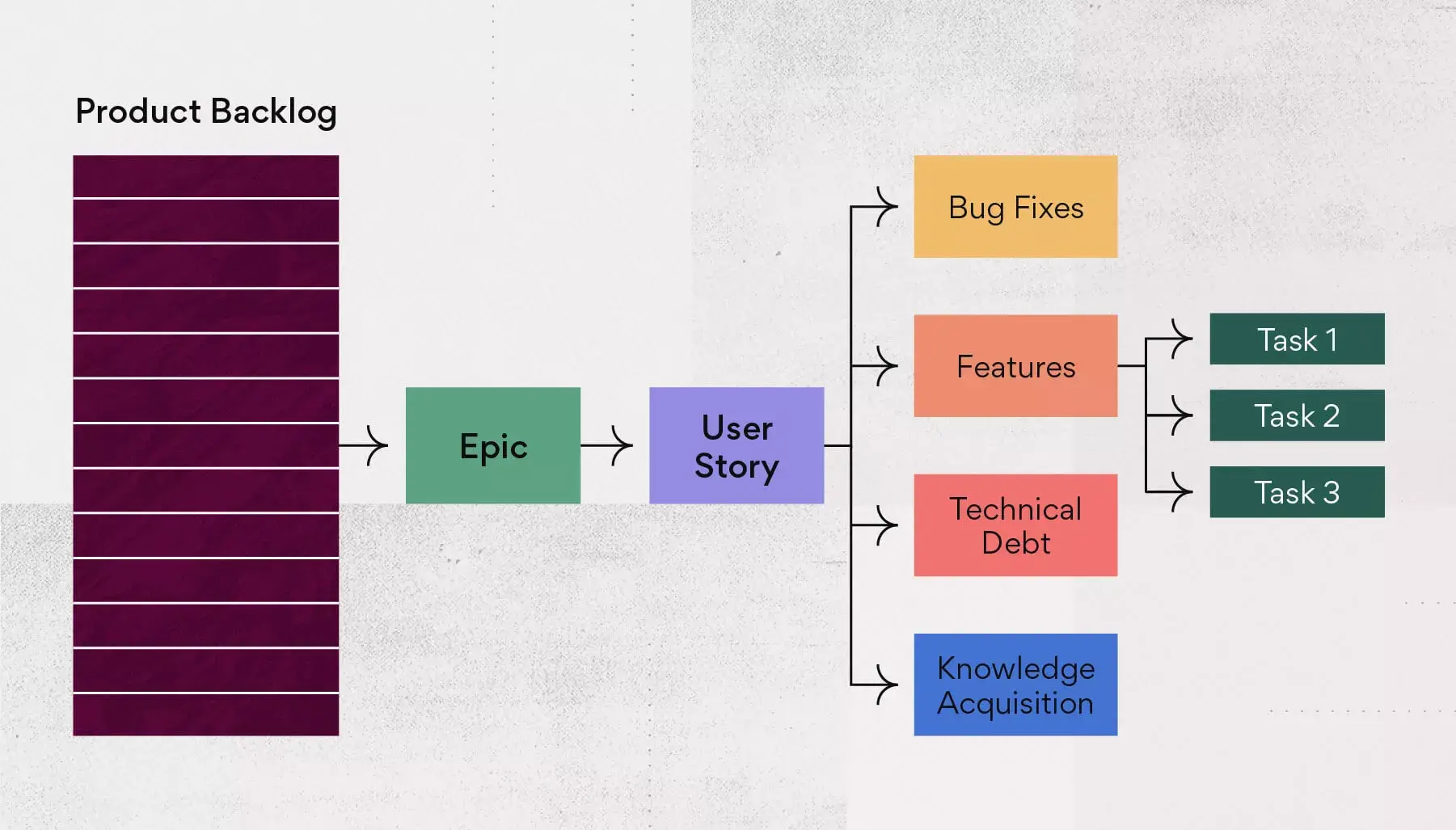
A product backlog commonly includes four types of items:
Features (user stories): Functions that deliver value to users
Bug fixes: Corrections to existing functionality
Technical debt: Maintenance work that improves code quality
Knowledge acquisition: Research tasks like prototypes or experiments
Now, let’s take a closer look at each type.
1. Features (user stories)
A feature, also known as a user story, is a function of the product that the product user finds valuable. Features can be complex, often referred to as epics, or they can be simple. Creating a story map can help your team determine what the user needs most.
2. Bug fixes
Bug fixes are straightforward, and your Scrum team should handle them quickly to keep the product working well. Some bugs are urgent and may need to be fixed right away, even during a sprint, while others can wait. It’s a good idea to keep bugs at the top of your backlog so they aren’t forgotten.
3. Technical debts
Technical debt, like financial debt, "accrues interest" when ignored. When developers push technical work to the bottom of the product backlog, it accumulates and becomes harder to deliver. Effective backlog management can prevent the buildup of technical debt.
4. Knowledge acquisition
In knowledge acquisition, you gather information to accomplish future tasks. When you identify a feature that needs further research, you create a knowledge-acquisition task, such as a prototype, experiment, or proof-of-concept, to gather the information you need.
Who owns the product backlog?
The product owner is responsible for the product backlog. They decide what belongs on the list, how items are prioritized, and when tasks should be tackled.
Even though the product owner is in charge, managing the backlog is a team effort. The product owner works with the Scrum master, development team, and stakeholders to refine items and make sure the backlog matches what users really need.
What is product backlog vs. sprint backlog?
Sprint backlogs are a subset of the product backlog, used specifically during sprints. Here's how they compare:
Product backlog | Sprint backlog | |
Owner | Product owner | Development team |
End date | Ongoing | When the sprint ends |
Goal | Overarching product goal | |
Flexibility | Very flexible, based on customer needs | Less flexible once the sprint begins |
What are the benefits of a product backlog?
Keeping your product backlog up to date helps your team stay organized and on the same page. Here are the main benefits:
Improved collaboration: The backlog becomes a central communication tool, keeping everyone aligned on goals and expectations.
Better iteration planning: Because all work flows through the backlog, teams can accurately determine how much to commit to each sprint.
Flexibility: Tasks aren't set in stone. Your team can reprioritize as needs change, promoting a productive yet adaptable work environment.
Clear priorities: The ordered list ensures everyone knows what work matters most at any given time.
4 steps to create a product backlog
A product backlog is more than a simple to-do list. It's where you break down complex tasks into a series of steps and delegate them to team members. Follow these four steps to develop an effective product backlog.
1. Build a product roadmap
The product roadmap is the foundation for the product backlog. Your team should create a roadmap first, which will then serve as the action plan for how your product will change as it develops. The roadmap is the vision for long-term product development, but it can also evolve.
Read: Project roadmaps: What they are and why you need them2. List product backlog items
With your product roadmap in mind, your team can begin listing product backlog items. These items should include both high-priority items and more abstract ideas. During this phase, you'll also need to communicate with stakeholders and listen to their ideas for product improvements.
If you're using the Agile method, you can organize this conversation during your sprint planning meeting.
3. Prioritize your backlog
After your team lists all the product backlog items, sort and prioritize your most important tasks. You can identify top-priority items by putting the customer front of mind and considering what items provide the most value to them.
Read: How to solve problems using the design thinking process4. Update regularly
As your team works through the backlog, keep in mind that it’s always changing. You can keep adding new items and updating priorities as you go.
How to prioritize product backlog items
An essential component of managing the product backlog is prioritizing tasks. As the Scrum master, you should have a thorough understanding of what new features stakeholders want to see in the product. Here are some strategies for prioritizing backlog items.
Refine product backlog items
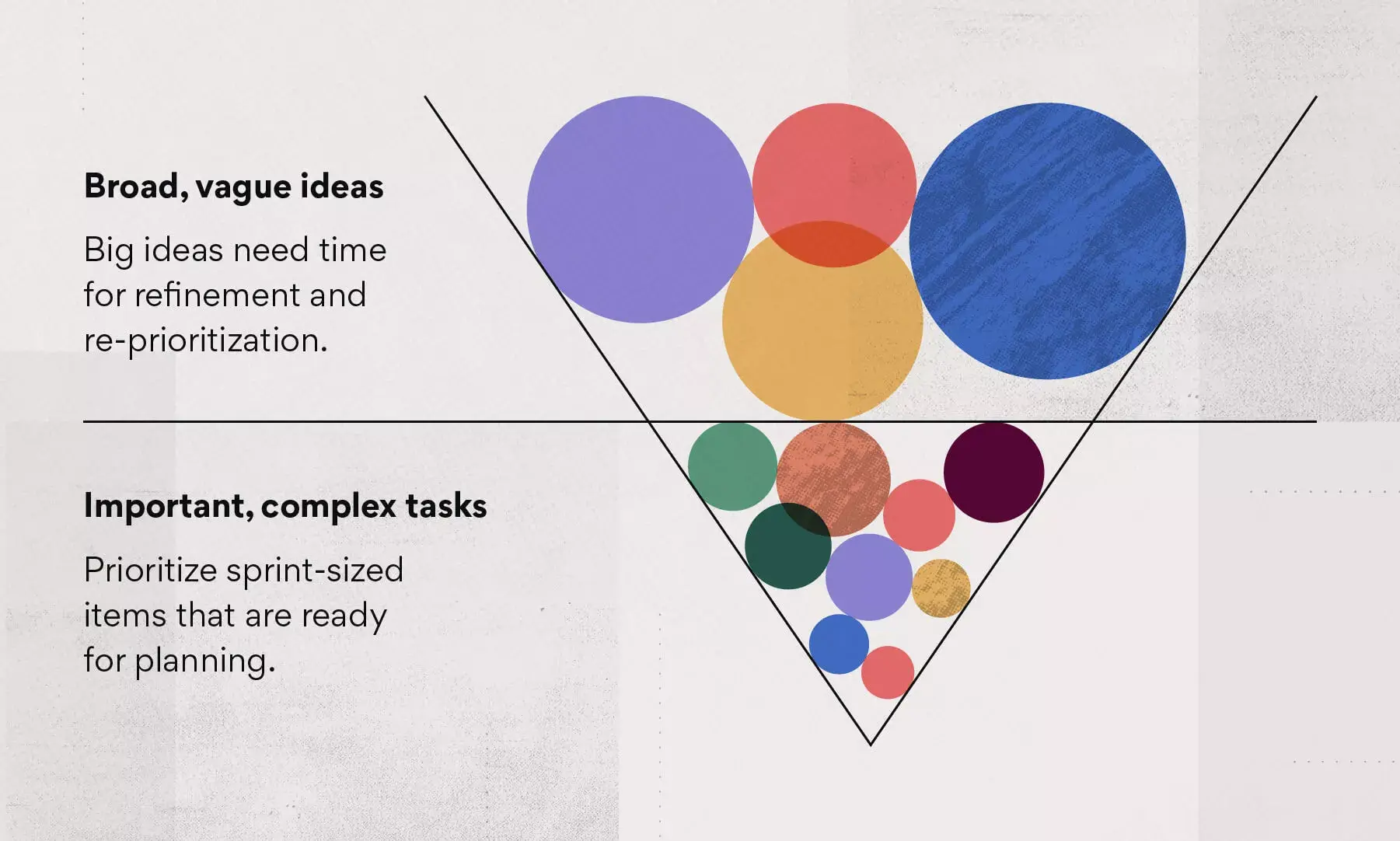
Before you can prioritize, you first need to define your backlogs. Add details such as a description, story points, and associated goals or metrics.
Organize tasks by urgency and importance
When focusing on backlog refinement, try organizing tasks with a priority matrix based on urgency and importance. The team should prioritize product backlog items that improve the product's functionality and user experience.
Read: How to prioritize your most important workTackle complex tasks first
Your team may feel inclined to complete simple tasks first so they can remove them from the product backlog and shorten the list. However, this is a less efficient form of project management. The product backlog will continue to grow, so tackling complex tasks first is often the most effective approach.
Complete tasks in focused sprints of time
Agile teams work in focused sprints to get things done, which helps boost productivity. At the end of each sprint, the product owner and development team check to make sure everything is on track.
Read: Burndown chart: What it is and how to use it (with examples)Communicate with your team
Communication between team members is a crucial part of product backlog prioritization. To successfully sort through the backlog and complete items in a reasonable timeframe, you and your team must work together and follow the Scrum Guide.
Read: 12 tips to effective communication in the workplaceHow to refine and maintain your product backlog
Product backlog refinement, sometimes called backlog grooming, is a continuous improvement process of reviewing, updating, and clarifying backlog items. This activity keeps your backlog healthy and ensures items are ready for upcoming sprints.
During refinement sessions, the product owner and development team work together to:
Break down large items into smaller, more manageable tasks
Add details like descriptions, acceptance criteria, and estimates
Remove outdated or irrelevant items
Reprioritize based on new information or changing business needs
Clarify requirements, so the team understands what needs to be done
Most teams spend about 10% of their sprint time on refinement. Regularly refining the backlog keeps it manageable and helps your team know what’s coming up next.
Product backlog example
Product backlogs look different between projects, but some begin with an epic. An epic is an overarching problem you're trying to solve for a customer. Here's an example below:
Epic: As a marketing manager, I want a content management system that allows me to deliver quality content to my readers.
This epic can lead to user stories, like how someone creates content in your new system or how they edit and share it with their team. To keep building our example, we can break the epic into more detailed user stories.
Story 1: As a content creator, I want a content management system that lets me create content to inform customers about our products.
Story 2: As an editor, I want a content management system that lets me review content before it's published, ensuring it's well-written and optimized for search.
The product owner, Scrum master, and development team will determine which features the product should include from the user stories and prioritize them by importance.
Features the product should include for Story 1:
Log in to the content management system
Create content
Edit a page of content
Save changes
Assign content to the editor for review
As the product manager, you'll use epics to guide your product roadmap and backlog list items. As this example shows, one epic can result in multiple user stories and product features.
Manage your product backlog with Asana
Getting a product to the finish line is easier when you have a well-organized product backlog. Asana can help you manage Agile projects in the most efficient way possible with modern Scrum software. Get started today and see how Asana keeps your team aligned and your backlog on track.
Create a product backlog template