Asana acquires StackAI — now every human-agent workflow runs in one place.Learn more
Get new hires up to speed faster
Keep your team’s priorities on track with streamlined employee onboarding and shorter ramp-up periods.

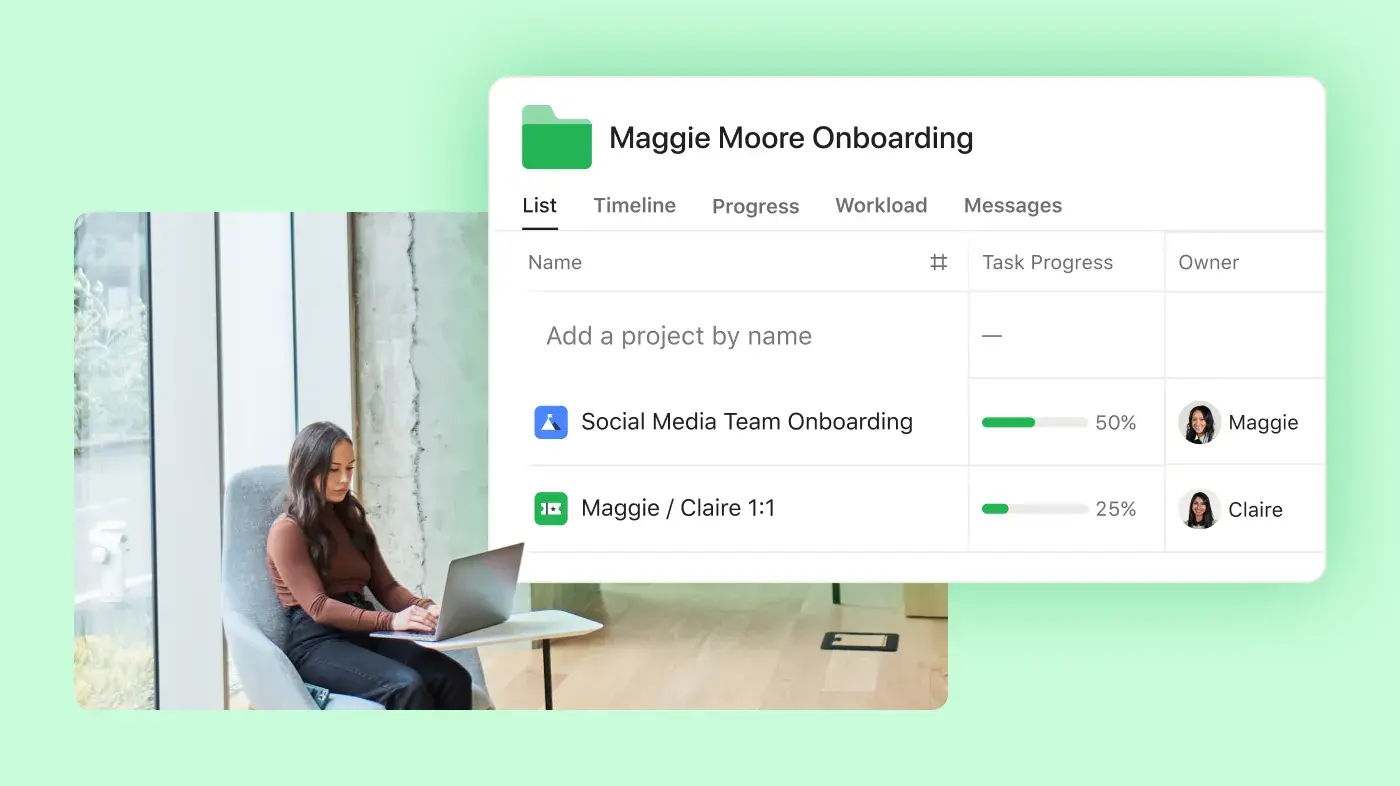
Centralize onboarding resources
Share training materials in one hub so new hires stay on track.
Drive engagement and accountability
Show new team members why their work matters with clear goals.
Help teams improve over time
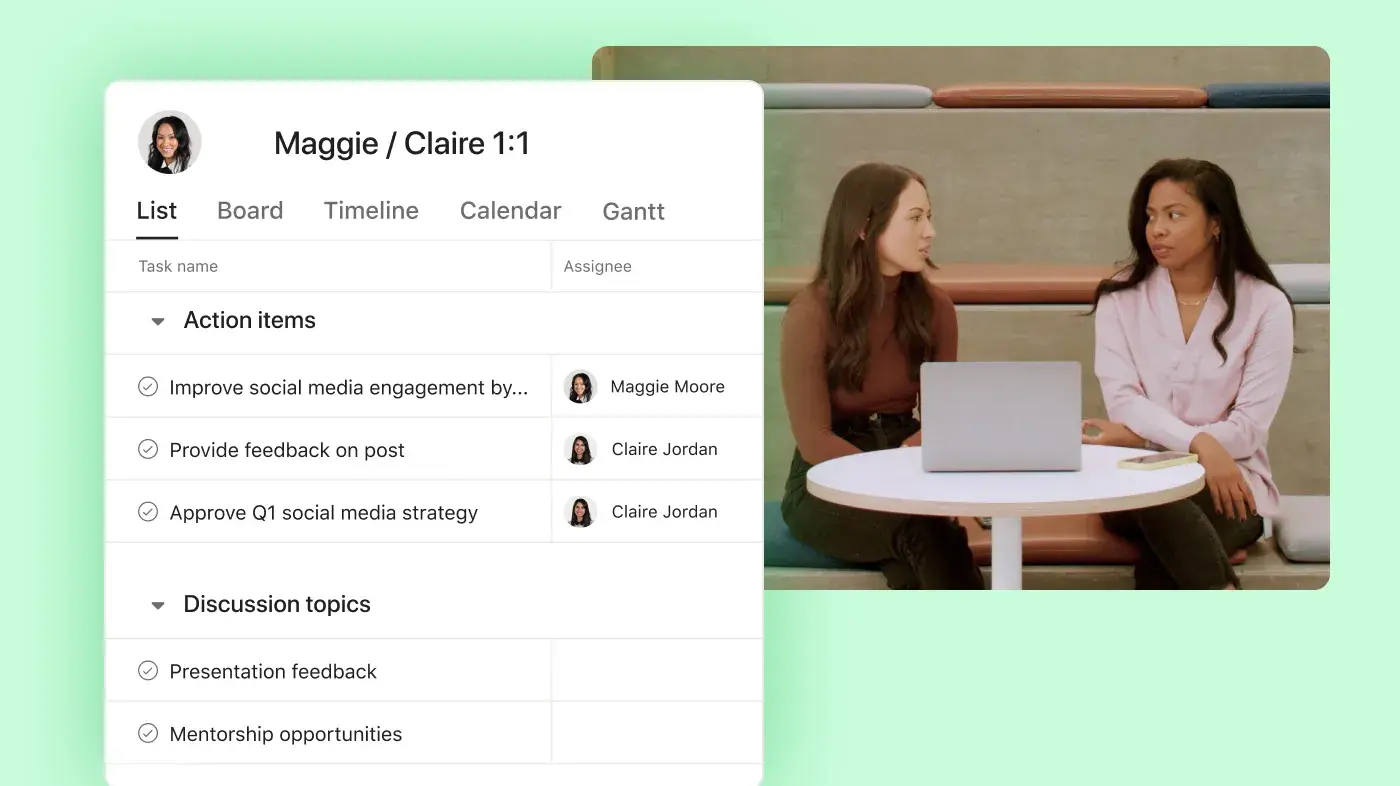
Create shared spaces for 1:1s and development conversations.
Simplify your process
Share resources and action items in one place with structured onboarding projects and portfolios.
Provide a clear action plan with concrete tasks for the first week, month, and more.
Streamline user setup with our Okta and Azure Active Directory integrations.
Be clear from the start
Keep new team members accountable by connecting their work to individual, team, and company goals.
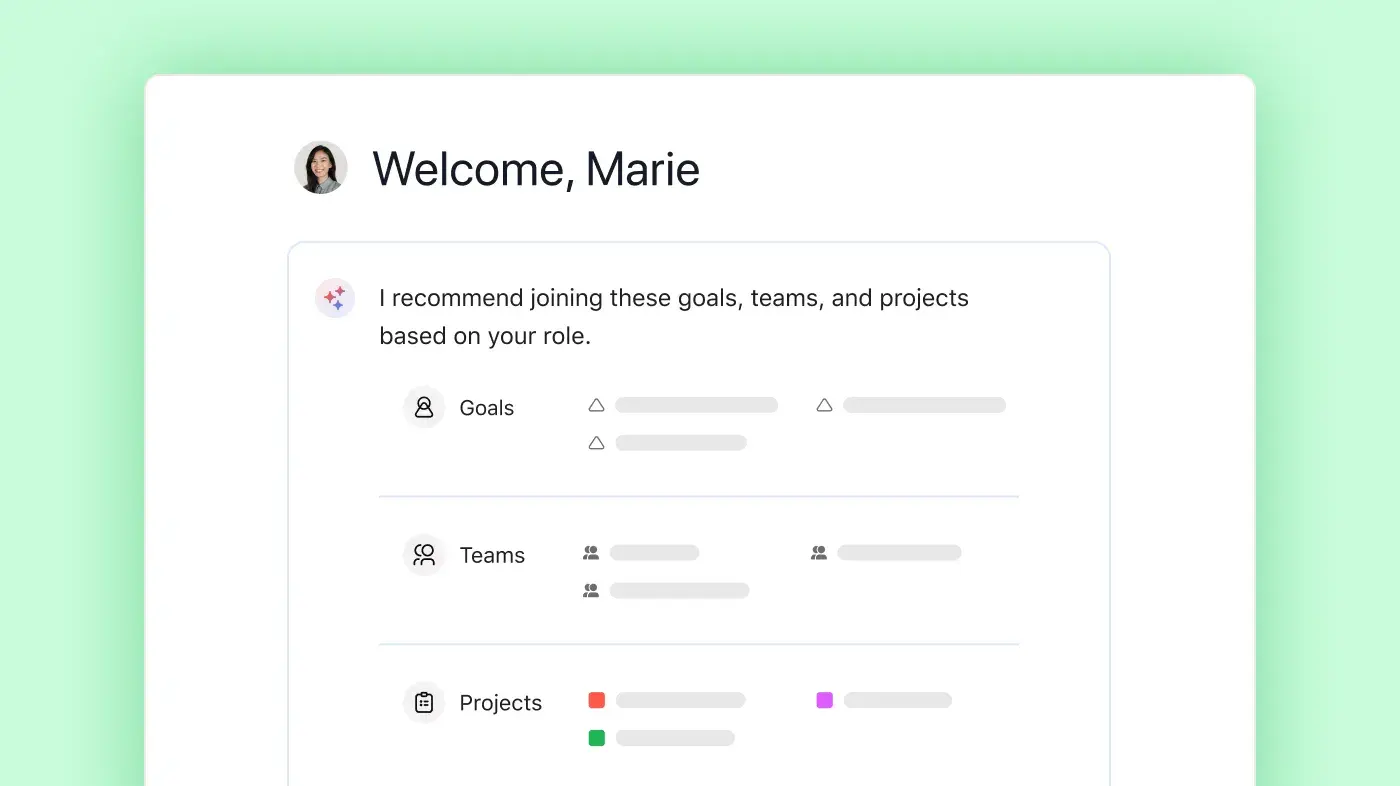
Let AI automatically suggest the best goals, projects, and teams for new hires to join.
Use Asana’s help center and AI-powered support bot to answer product questions quickly.
Make logins painless
Onboarding is complicated enough. Help new team members access the tools they need quickly and easily.


Employee onboarding templates
Get new team members up to speed faster with pre-made templates from onboarding experts.
Employee onboarding template
Get an inside look at how we structure onboarding at Asana.
1:1 meeting template
Keep track of agenda items, meeting notes, and next steps in one place.


Company Size
Enterprise
Industry
Technology
Asana is perfect for onboarding, and it helps our team effectively replicate our work.
Aleksandra Sulimko
Chief Human Resources Officer, TheSoul Publishing
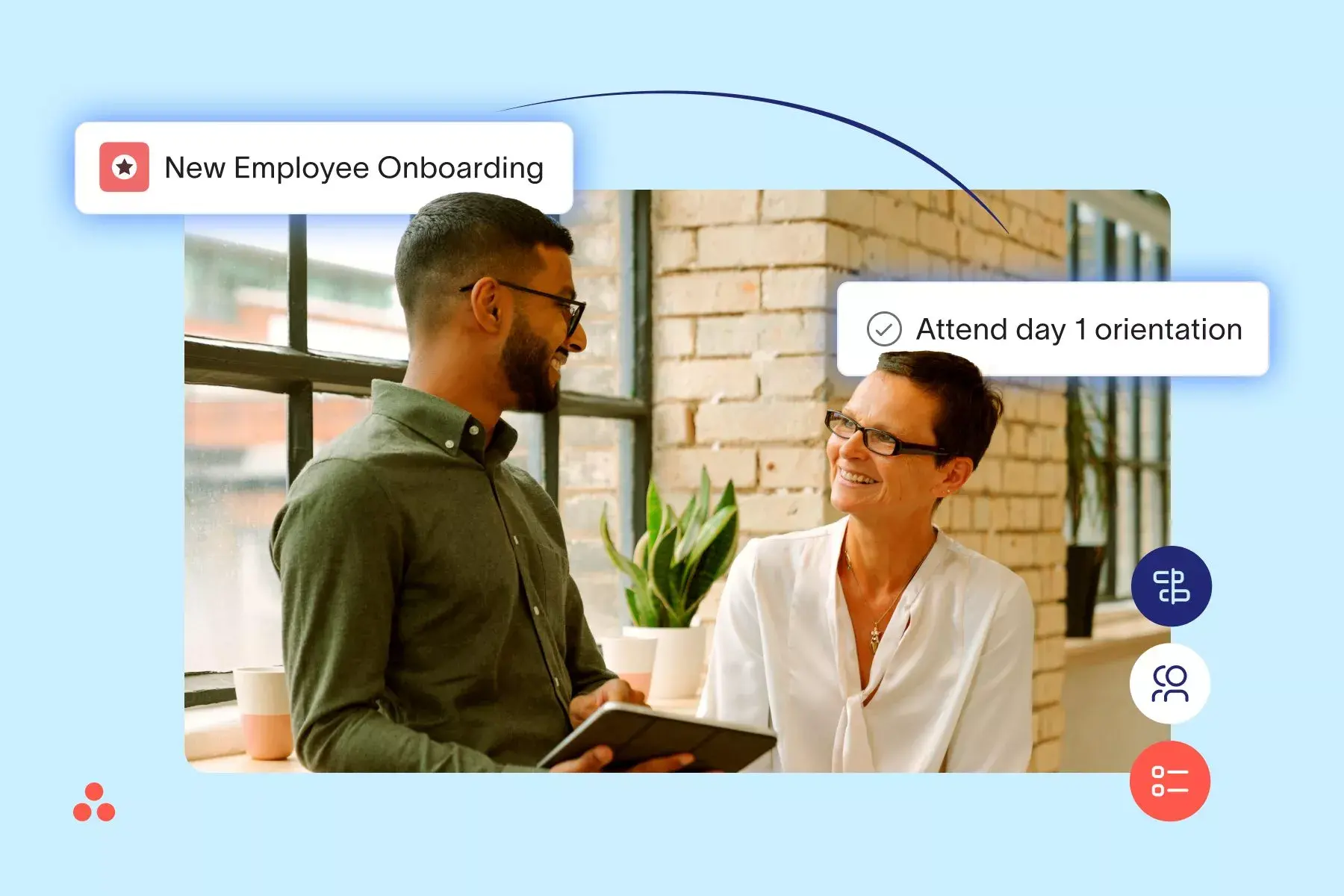
Onboarding tips
Explore expert tips to create a faster and more effective onboarding process.

Still have questions? We have answers.
What are the 5 C's of employee onboarding?
What is the 30-60-90 day onboarding rule?
What are the stages of the employee onboarding process?
How long should employee onboarding last?
Why do I need software for new employee onboarding?
How should I choose an employee onboarding tool?
Transform the way you work with Asana
Start your free trial
Try Asana for free. No credit card required.
Watch the demo
See how Asana connects companies at scale.
Speak with a sales rep
Learn how Asana helps teams collaborate seamlessly.
Employee onboarding process: 4 steps + checklist guide
You've invested time and resources to hire the best candidate. Now it's time to help them succeed with a structured employee onboarding process.
Onboarding is more than just training for a new job. When it’s done well, it helps new hires learn quickly, grow in their roles, and start making a difference sooner.
Let’s look at how onboarding works.
What is an employee onboarding process?
An employee onboarding process is a step-by-step approach to welcoming new hires and helping them become productive team members. It usually lasts a few months and covers training, introductions, learning about company culture, and ongoing support to help employees succeed over time.
A good onboarding process makes sure every new hire gets the information they need when they need it. Here are the main parts:
Standardized experience: Consistent steps for every new employee
Centralized information: A single repository for all onboarding materials
Clear timeline: Scheduled introductions and trainings so new hires know what to expect
Onboarding vs. orientation
While often used interchangeably, onboarding and orientation serve different purposes. Here's how they compare:
Orientation: One-time event (1–2 days)
Onboarding: Ongoing process (3–12 months)
Orientation: Focuses on paperwork and policies
Onboarding: Includes training, culture, and relationships
Orientation: Introduces basic company information
Onboarding: Builds role-specific skills and connections
Orientation: Administrative focus
Onboarding: Strategic focus on long-term success
Orientation is just the beginning of onboarding, not a substitute for the whole process.
How effective onboarding can benefit your team
An effective onboarding program helps new team members feel welcome, boosts productivity, and improves employee satisfaction, which encourages great talent to stay longer. Research by Brandon Hall Group reveals that strong onboarding can increase retention rates by 82%. Yet only 12% of employees strongly agree their organization does a great job onboarding new hires.
Here’s how building a better onboarding experience can help fix this problem.
It drives engagement and accountability
For new employees to do well, they need to know what’s expected of them and why their work is important. Onboarding is an opportunity for leaders to set clear goals, provide feedback, and keep communication open.
Here's how leaders can set up their new hires for success:
Use goals to set clear expectations. Set goals to give team members a clear definition of success and metrics to measure their progress. For example, you could set goals for what the new hire should accomplish within their first 30, 60, and 90 days. These can be smaller short-term goals to start, like trainings they should complete in their first few weeks. Later, you can follow up with the new hire to set measurable long-term goals and a professional development plan for their first year on the job. Make sure each objective you set is SMART: specific, measurable, attainable, realistic, and time-bound.
Build trust with feedback. Effective feedback is essential for workplace communication and employee engagement because it helps people grow and improve. Soliciting feedback from new hires encourages them to ask for what they need and demonstrates that you value their input. Conversely, giving feedback helps new colleagues learn and feel safe in their role, because they can trust that you'll tell them if they're doing something wrong.
Assign a mentor or onboarding buddy for your new hire. A mentor meets regularly with your new hire and is typically a peer on their team; in other words, a mentor is someone the new hire can talk to other than their manager, so they have a space to bring up issues in a low-pressure environment. Assigning a mentor during onboarding can also encourage people to stay with your team longer. According to a case study at Randstad, employees who participated in mentoring programs were 49% less likely to leave, in addition to saving the company $3,000 per participant per year.
Be specific about how your team communicates. This is especially important for virtual teams and remote employees, because it's harder for new hires to ask questions when they're not physically at the office. Create and share a communication plan that outlines who to talk to for specific issues, which communication tools to use for what, how often team members should communicate status updates and project details, and what requires an in-person (or virtual) meeting rather than asynchronous communication. It's also helpful to set expectations around instant messaging apps like Slack; for example, you could emphasize that team members don't need to respond to messages immediately.
It gives new hires time to learn
Starting a new job can be overwhelming. New hires have to learn new skills, become familiar with company processes, understand their role, and learn to work with others. A structured onboarding process gives them time to absorb all this information and prepare for their new responsibilities.
Here's how you can prioritize learning during onboarding:
Make your onboarding process at least three months long. Most onboarding programs end far too quickly: 62% wrap up in less than a month, and only 26% of employees say their most recent onboarding left them fully informed, engaged, and confident. But that leaves little time for new hires to become confident in their roles. Ideally, onboarding should last from three to six months to allow new hires to ramp up gradually. Research suggests that organizations with strong onboarding processes increase productivity by 70% and employee retention by 82%, so you may want to continue to look for and provide learning opportunities past the first three months of employment. This will help your new hire deepen their understanding of your company and team.
Allow new hires some unstructured time. Rather than scheduling nonstop training, give them space to read and explore on their own, especially in the first few weeks. Estimate how long it will take to review all the materials, then add extra time to account for breaks and time to absorb what they learn.
Make information easily accessible. Since new hires have extra time during onboarding to review project materials and documentation, the information should be easy for them to find. It's time-consuming to share individual files for your team members to read, and near-impossible to compile a comprehensive list of resources. That's where a work management program like Asana can help. When you share a project in Asana, team members can see all of the relevant tasks, documentation, and contributors, plus explore other related projects they might be interested in.
It builds a positive culture
Organizational culture is made up of all the norms, best practices, ideals, and shared values within your company. Investing in great culture benefits everyone; not only does it help team members feel supported, but it also encourages them to grow and produce their best work.
A positive culture begins with a good first impression. Here’s how your onboarding plan can help create a welcoming workplace:
Communicate your core company values. Values describe how new team members can expect to be treated and provide guidelines for employees to collaborate with mutual respect. For example, some of Asana's values include "Start with Heart," "Solve it Together," and "Act as you own it."
Set the standard for diversity, inclusion, and belonging. Every team member should feel like they belong. For example, you could include a diversity, inclusion, and belonging learning session in the onboarding process for all new employees to learn about your company standards and employee resource groups. Additionally, let new hires know about any special events where team members can candidly discuss their experiences with identity and workplace challenges.
4 steps to create an effective onboarding process
Creating a great onboarding program may seem daunting, but you don't have to reinvent the wheel. Whether you're building off existing processes or using an employee onboarding template, these four steps will help you effectively onboard new team members.
1. Determine what new hires need to know
At its heart, onboarding is about learning. That means it's important to determine what new hires need to know for their roles so you can ensure they receive the information and training they need. Think beyond just hard skills; this can also include details like your company culture and values, your teamis structure, and how employees give and receive feedback.
Try to separate key information into two buckets: details that all new hires should know, and details specific to a new hire's role or job description. For example, all new employees should learn about your company culture, but only engineers need to learn about your company's development stack.
Not sure where to start? Here are some examples to get you started.
For all new employees
Company culture and values, such as how new hires can expect to be treated and what your organization does to create a good employee experience, where everyone feels welcome.
Company policies and processes, such as how annual review cycles are conducted and how employees should request time off. If you have one, an employee handbook is a great way to share this information.
Team processes, such as how your team communicates and the purpose of different team meetings.
Team structure and responsibilities, so new hires know who to reach out to for specific problems or questions.
For specific roles
Job skills. For example, a designer may need to understand the look and feel of your company website.
Tools. For example, an account manager may need to learn how to manage leads in a CRM tool.
Role-specific processes. For example, an IT manager should learn how to put in an order for replacement computers.
Individual responsibilities and expectations. For example, the responsibilities and expectations for a team lead differ from those of an entry-level individual contributor.
2. Outline logistical requirements
Next, determine the logistical tasks that need to be completed on or before your new hire's start date. This is usually a combination of tasks for you, the new hire, human resources, and IT. For example, this might include:
Tech setup. For example, requesting and setting up a computer for the new hire.
Office access, such as creating a new employee access badge.
Setting up a physical workspace. This could mean setting aside an office or desk space, or providing a benefit so new hires can purchase home-office equipment.
HR tasks, like setting up benefits and direct deposit.
Access to tools. For example, you may need to create accounts so the new hire can access online tools and team software.
Required security and privacy training.
Keep in mind that your company may already have processes in place for some or all of these requirements. As a first step, check with your IT and HR departments to see what's automatically handled for new hires and what you need to drive.
3. Determine who new hires should meet
Part of the onboarding process for new hires is meeting coworkers and cross-functional partners they'll work with regularly. As a manager, you can help your new hire make the right connections during onboarding so they're clear who they should be working with on which projects. Make a list of everyone your new hire should meet during their first weeks on the job; later, you can use this information to schedule introduction meetings.
If you've opted to assign a mentor for the new employee, now is the time to specify who that person will be. Your new hire's mentor should be among the first people they meet regularly. Their mentor may also have suggestions for people they should meet during their first few weeks.
And most importantly, make sure your new hire has dedicated time to meet their fellow team members. This can include group events, like a team lunch on their first day, as well as 1:1 time with each new teammate.
4. Create an onboarding timeline
Now it's time to put it all together and create an onboarding timeline. An onboarding timeline outlines when each step of the new-employee onboarding process should occur, so your new hire has a clear workflow to follow from day one onward. Your timeline should address the following questions:
When will the onboarding process start? You may want to start the logistical aspects of onboarding before an employee's first day, such as setting up their direct deposit and tax information, preparing their equipment, and sending a personal welcome message from your team.
How long will onboarding last? Now that you know what your new hire needs to learn, you can estimate how much time it will take. Be sure to include extra time for breaks and to process new information. Let new hires know how long onboarding will take, but remember, you can adjust the pace based on how quickly they learn.
When should you schedule training sessions to pass along key information? For example, you might want to schedule high-level employee orientation sessions on company processes in the first week, and skills training during the second and third weeks.
When does your new hire need to learn and start using specific skills? Try to time skills training sessions close to when the new employee will actually put those skills into practice. That way, they have an opportunity to solidify their understanding and ask questions that weren't addressed during training.
Who should your new hire meet with, and when? For example, they might check in with their mentor every day during their first week, and meet cross-functional stakeholders during their second or third week.
What goals should your new hire achieve by the first day, week, month, and so on? These should be clear expectations for what the new employee should accomplish by when. For example, a new recruiter on your team may have a goal to shadow a hiring process with one of their peers during their first month. Keep in mind that goals are a starting point; you can still work with your new hire to adjust objectives as needed.
When will you meet with the new employee to give and receive feedback? This can include informal check-ins to see how things are going and what can be improved, as well as more structured feedback sessions at the end of the new hire's first month or 100 days.
Common onboarding mistakes to avoid
Even well-intentioned onboarding programs can fall short. Here are some common pitfalls to watch out for:
Overwhelming new hires on day one. Bombarding employees with too much information in their first few days can lead to confusion and anxiety. Instead, spread out training sessions and give new hires time to gradually absorb the information.
Skipping preboarding activities. The time between accepting an offer and starting a new role is valuable. Use this period to complete paperwork, send welcome materials, and set up equipment so new hires feel prepared before their first day.
Neglecting feedback and check-ins. Without regular touchpoints, new employees may struggle in silence. Schedule consistent one-on-ones to address questions, provide guidance, and gauge how well the onboarding process is working.
Relying too heavily on automation. While technology can streamline tasks, onboarding is fundamentally about human connection. Balance automated workflows with personal interactions from managers, mentors, and teammates.
Treating onboarding as a one-day event. Orientation is just the beginning. Effective onboarding extends over several months, giving new hires time to build relationships, develop skills, and fully integrate into your team culture.
Example new hire checklist
An onboarding checklist is a useful tool to ensure your onboarding process includes all the steps necessary to set new hires up for success. This can be a version of your onboarding timeline, with individual tasks grouped in sections for your new hire's first day, week, month, and so on.
Using work management software like Asana can help make your onboarding checklist actionable. Here's how:
Create linked tasks: Add relevant information and specific due dates to each task
Assign ownership: Distribute tasks to yourself, IT, HR, or your new hire
Automate workflows: Instantly assign the right tasks to stakeholders at the right time
That way, your checklist becomes a living resource you and your new hire can work from together.
Get new hires up to speed faster
With these steps, you can onboard new team members with confidence. Taking the time to create a successful onboarding process not only helps employees succeed in their new role but also helps them hit the ground running with all the skills, information, and connections they need to make an impact.
Ready to streamline your onboarding process? Get started with Asana to organize tasks, track progress, and keep every new hire on the path to success.